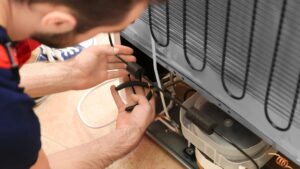
Most people have no idea how long their refrigerator is actually supposed to last. It sits in the kitchen running quietly for years, and because it doesn’t demand much attention, there’s rarely a reason to think about it until something goes wrong. Then, when a repair becomes necessary, there’s no frame of reference for whether spending money on it makes sense or whether the appliance has simply run its course.
How long a refrigerator should last is a more nuanced question than most appliance guides suggest, because the answer depends heavily on the type of unit, how it’s been maintained, and the environment it’s been running in. Here’s what the numbers actually look like, and how to make the repair-or-replace decision with confidence.
The Real Average Lifespan of a Refrigerator
The appliance industry and consumer research organizations generally agree on a lifespan range of 10 to 18 years for refrigerators, with the average falling somewhere around 13 years. That’s a wide range, and it exists because several factors have a significant impact on how long any individual unit lasts.
According to the U.S. Department of Energy, a refrigerator is one of the highest-energy appliances in a typical home, running continuously every day of the year. That constant operation means wear accumulates steadily, and the quality of components, the maintenance habits of the owner, and the conditions the appliance operates in all shape how quickly that wear adds up.
Configuration matters more than most people realize. Top-freezer refrigerators tend to be the most reliable and long-lasting, often exceeding the 15-year mark when properly maintained. Bottom-freezer models are close behind. Side-by-side refrigerators and French door models have more components, more complexity, and more potential failure points, and they tend to average closer to 10 to 13 years before significant issues arise.
What Shortens a Refrigerator’s Life
A refrigerator that runs well for 15 years in one home might need major repairs at 10 years in another, and the difference is almost always traceable to a few specific factors.
Dirty condenser coils are one of the most overlooked contributors to premature refrigerator failure. The condenser coils release heat from the refrigerant as part of the cooling cycle. When they accumulate dust and debris, the refrigerator can’t shed heat efficiently, so the compressor runs harder and longer to maintain the set temperature. Over months and years, that extra strain shortens the compressor’s life considerably. Cleaning the condenser coils once or twice a year is a simple task that extends the life of the appliance significantly.
Running a refrigerator in a warm or poorly ventilated space is another common issue. A refrigerator in a hot garage or a tight corner with no clearance for airflow works much harder than one in a climate-controlled kitchen with proper ventilation. The compressor has to overcome the ambient heat to maintain internal temperatures, which adds stress to the sealed system over time.
Florida’s climate introduces a consideration that doesn’t apply in cooler, drier parts of the country. The heat and humidity that define the Orlando area year-round mean that refrigerators here run harder than they would almost anywhere else. Compressors work continuously against ambient temperatures that rarely drop to the levels seen in northern states, and the humidity accelerates wear on door gaskets, which have to maintain a tighter seal to keep moisture out of the refrigerator interior. A unit that might last 15 years in Minnesota may show wear a few years earlier in Central Florida, and that’s worth accounting for when making a repair decision.
Signs Your Refrigerator Is in Decline But Not Done Yet
There’s an important distinction between a refrigerator that’s showing signs of aging and one that’s genuinely at the end of its life. Several symptoms that feel alarming are actually indicators of fixable problems that have nothing to do with the overall lifespan of the appliance.
A refrigerator that runs constantly or cycles more frequently than usual is often dealing with dirty condenser coils, a worn door gasket, or a temperature sensor that’s reading incorrectly. All three of these are repairable issues at a reasonable cost, and fixing them can restore the efficiency and performance of the unit without any major intervention.
Frost buildup in unexpected places, such as on the back wall of the refrigerator compartment rather than only in the freezer, usually points to a defrost system issue. The defrost heater, thermostat, or defrost control board may have failed, allowing ice to accumulate on the evaporator coil. This is a repair that a technician can complete without replacing the appliance.
Visible condensation on exterior panels, particularly around the door frame or on the sides of the refrigerator, often indicates a door gasket that’s no longer sealing properly. A gasket replacement is one of the least expensive refrigerator repairs available, and it resolves the condensation problem while also reducing the load on the compressor.
For homeowners in the Winter Park and Oviedo areas dealing with any of these symptoms, Appliances USA Pro’s Winter Park team and Oviedo technicians can diagnose the issue and give you an honest repair assessment on the same visit.
The Clear Signs It’s Time to Replace
Some situations genuinely do tip the scales toward replacement, and recognizing them saves you from putting money into an appliance that won’t hold up much longer, regardless.
Compressor failure on a refrigerator older than 12 years is the most common clear case for replacement. The compressor is the most expensive component in the sealed system, and replacing it often costs between $500 and $1,000 or more, including labor. On a unit that’s already past the midpoint of its expected lifespan and potentially facing other aging-related issues, that investment rarely makes financial sense.
Refrigerant system leaks on older units can also tip toward replacement, especially if the unit uses an older refrigerant type that’s been phased out or is harder to source. Repairing a leak involves finding and sealing the source and then recharging the system, which can be expensive, and if the sealed system is aging more broadly, the leak may return.
Multiple component failures within months of each other are a clear signal that the appliance is in a general state of decline. One repair over 10 years is completely normal. Two or three repairs within a short window suggest the refrigerator has reached the point where failures will continue regardless of what’s fixed, and further investment is unlikely to produce long-term stability.
Repair vs. Replace: A Framework That Actually Works
The most useful framework for making this decision combines three factors: the age of the unit, the cost of the repair, and the energy efficiency of the refrigerator compared to a modern replacement.
A repair is almost always worth it when the refrigerator is under 10 years old and the repair cost falls well below half the price of a comparable new unit. Even at the 10 to 12-year mark, most repairs short of a compressor replacement are reasonable to pursue.
Energy efficiency deserves more consideration than most people give it. Energy Star-certified refrigerators use significantly less electricity than models from 10 or 15 years ago. If your current refrigerator is running inefficiently and driving up your electricity costs every month, a newer model may pay for part of its cost through energy savings over time. That doesn’t always tip the math toward replacement, but it’s a real factor that should be part of the conversation.
The most reliable approach is to ask a technician for an honest condition assessment before committing to either path. A thorough inspection tells you what the repair actually involves, what the rest of the appliance looks like, and whether the unit has the realistic condition to justify the investment. For refrigerator repairs throughout the Orlando area, including Kissimmee and Polk County, Appliances USA Pro provides exactly this kind of honest assessment before any repair begins.
About Appliances USA Pro
Appliances USA Pro provides refrigerator repair and full appliance service throughout the Orlando metro area. Whether your refrigerator is showing early signs of trouble or you’re facing a bigger repair decision, the team offers transparent diagnostics, upfront pricing, and honest recommendations with no upselling. Same-day and next-day appointments are available across the service area. Learn more about the team or book a visit online to get a clear answer about where your refrigerator stands.
Frequently Asked Questions
What is the average lifespan of a refrigerator?
Most refrigerators last between 10 and 18 years, with the average falling around 13 years. Top-freezer models tend to last the longest, while side-by-side and French door configurations average closer to 10 to 13 years due to their added complexity.
Is it worth repairing a 15-year-old refrigerator?
It depends on the repair. Minor repairs such as gasket replacements, sensor fixes, or defrost system components are generally worth completing even at 15 years. Major repairs, like compressor replacement on a 15-year-old unit, are harder to justify financially, and replacement is the more sensible option in most cases.
What are the signs that a refrigerator is going bad?
Common signs include running constantly without maintaining temperature, unusual noises from the compressor area, frost buildup in unexpected locations, condensation on exterior surfaces, food spoiling faster than normal, and a higher electricity bill without a clear explanation. Some of these are fixable. Others signal a more serious issue that warrants a professional assessment.
How do I know if my refrigerator compressor is failing?
Signs of a failing compressor include the refrigerator running continuously without cooling properly, a clicking or humming sound at the back of the unit when it tries to start, the compressor housing feeling very hot to the touch, and the interior temperature rising despite the thermostat being set correctly.
Does a refrigerator use more electricity as it gets older?
Yes, generally. Aging components like the compressor, door gaskets, and condenser coils operate less efficiently over time, which means the refrigerator has to run harder and longer to maintain the set temperature. This shows up as a higher electricity bill. Energy Star data shows that modern refrigerators are considerably more efficient than models from 10 to 15 years ago, which factors into the repair-vs-replace decision for older units.

Rafael Roa is an entrepreneur and business leader best known as the CEO of Appliances USA Pro, a trusted appliance repair and installation company serving homeowners and businesses across Central Florida. Through his leadership, dedication, and customer-first mindset, Rafael has helped build the company into a recognized name in the appliance service industry.
With a strong focus on reliability and professionalism, Rafael has guided Appliances USA Pro toward providing fast, efficient, and high-quality repair solutions for major household appliances, including refrigerators, washers, dryers, ovens, and dishwashers. His goal has always been simple: deliver dependable service that customers can trust while creating a smooth and stress-free experience from start to finish.
Rafael’s entrepreneurial journey reflects his passion for solving everyday problems and helping people when they need immediate support. He understands how disruptive appliance breakdowns can be for families and businesses, which is why he emphasizes quick response times, transparent communication, and skilled workmanship. Under his leadership, Appliances USA Pro has built a reputation for same-day service options, honest pricing, and customer satisfaction.
In addition to overseeing daily operations, Rafael Roa is committed to building a strong company culture based on accountability, integrity, and continuous improvement. He works closely with technicians and staff to ensure every customer receives professional and personalized service. His leadership style combines operational efficiency with a genuine commitment to customer care, helping the company continue to grow in a competitive market.